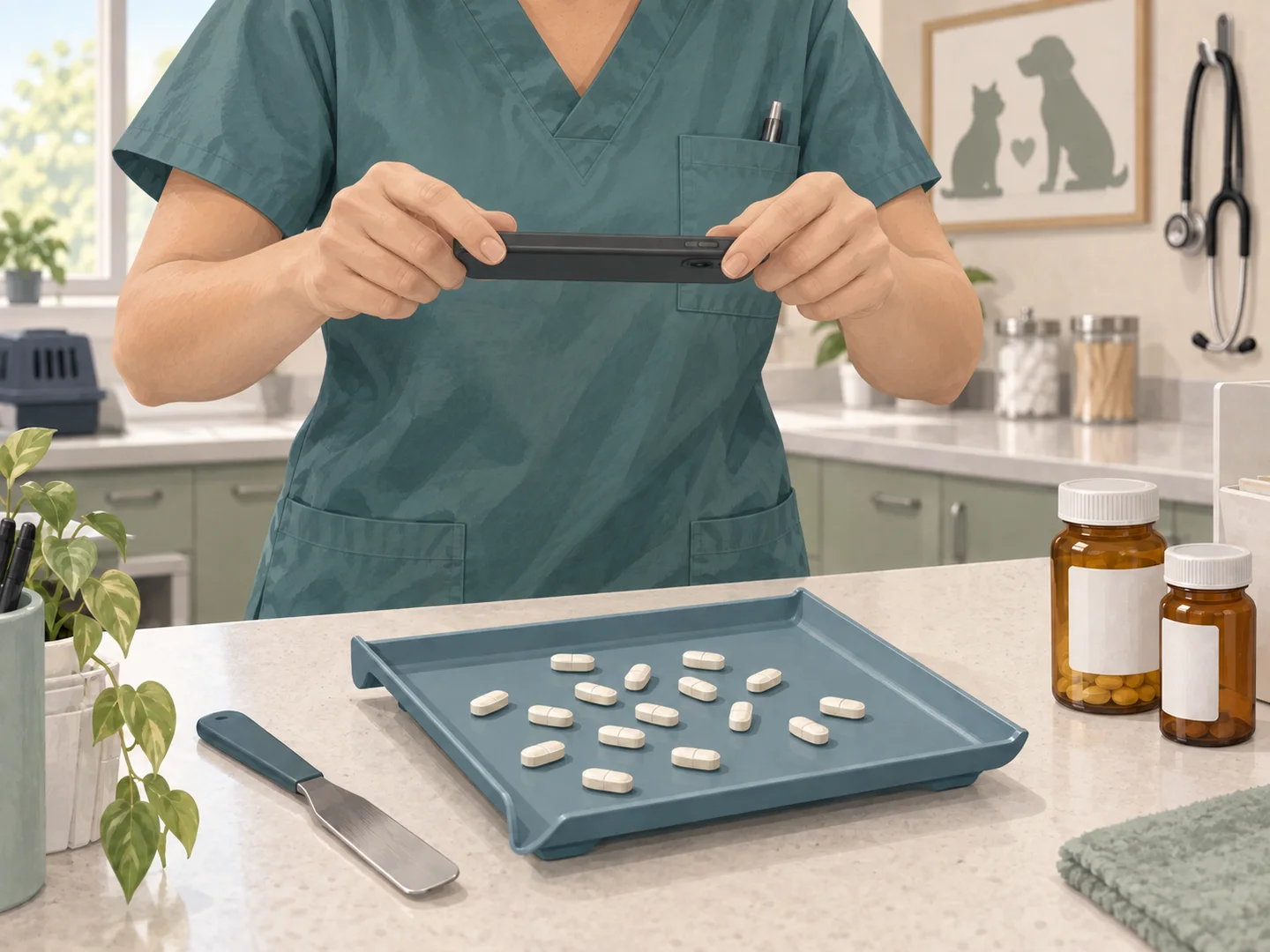
The veterinary pill counter in your pocket
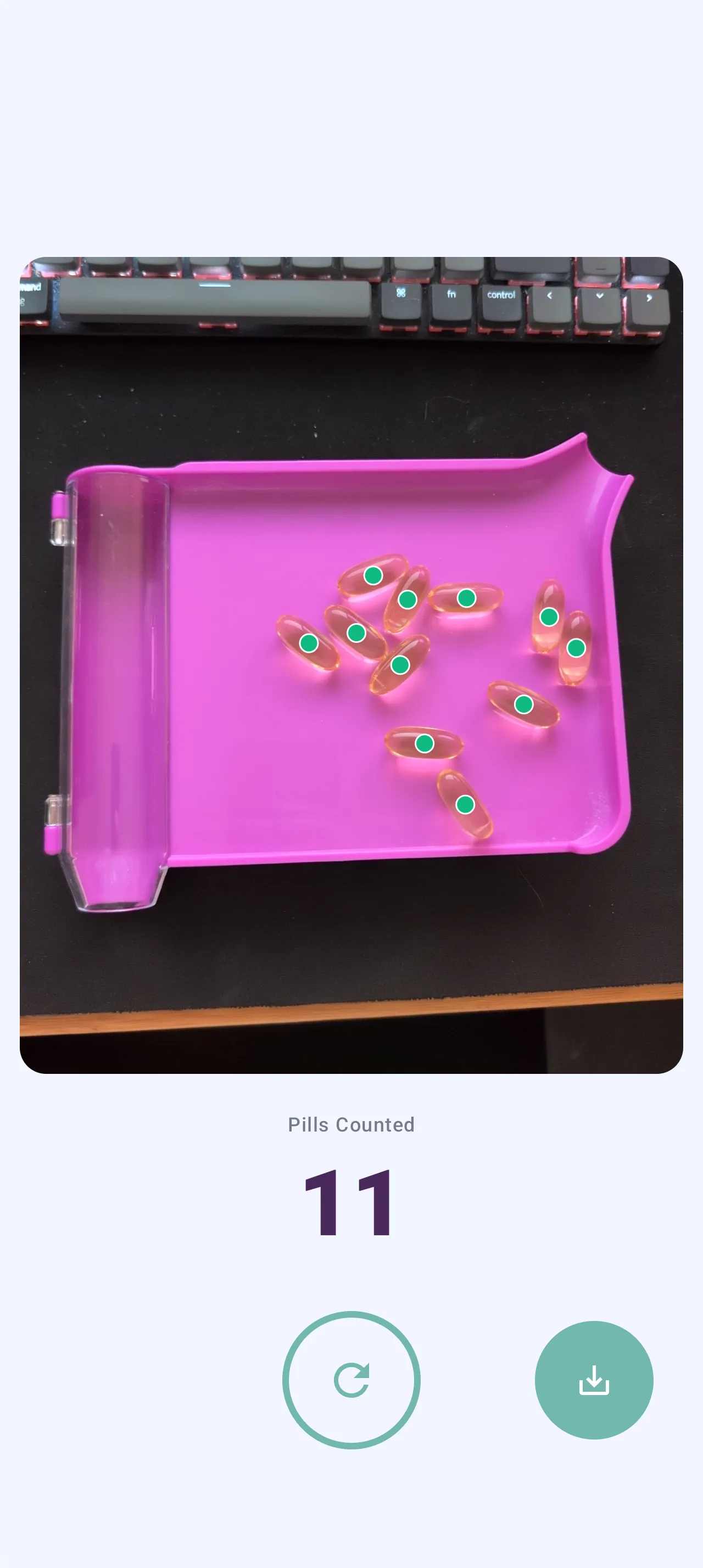
One photo of the tray, a count back in a few seconds, on the phone or tablet the practice already has. Every pill it found is marked on your own picture, so the number is something a second person can check. Free, no account, nothing to buy.
Why the counting never quite stops
Nobody goes into veterinary work to count tablets, and yet in a busy veterinary practice somebody is always counting them. A stock check where the shelf and the bottle have to agree. The end of a shift, when a number has to be put on what is actually left. A course of medication going out with a client, and the quiet wish to have looked at it twice before it went out the door.
Rescues and shelters get the same job in a different shape. Donated medication turns up in mixed bottles, part used, sometimes already split, and someone has to work out what is really in the box before any of it can be used or written down.
Counting by hand is fine right up until it is not. It is slow, it is interruptible, and a tally that got interrupted leaves nothing behind to check itself against. That is the part that stings a week later. Not that a number was wrong, but that there is no way to go back and look.
- Stock checks, where what the shelf says and what the bottle holds have to agree.
- End of shift or end of day, when someone has to commit to a number.
- A second look at a course of medication before it goes home with the client.
- Rescues and shelters working out what is in a box of donated, part used bottles.
- Splitting a long supply into weekly containers, which is the same tablets counted over and over.
What one photo gets you
Spread the tablets on a tray, a plate, or any flat surface that contrasts with them, hold the phone or tablet above it, and take one picture. The photo goes to our server, a vision model finds every pill in the frame, and the count comes back a few seconds later. The copy on the server is deleted once the count has been produced. Counting needs a connection, because the work does not happen on the device.
What comes back is your own photo with the work shown on it. Every pill the model found carries a marker, so the total is something you or a colleague can check by eye instead of taking on trust. Markers are tappable: tap one to take that pill out of the total and tap it again to put it back, which is how you deal with a stray detection, or with a bottle cap that was sitting on the tray.
A piece recognized as a broken half counts as 0.5 rather than 1, so a tray of wholes and halves reads in doses. Recognition is not a guarantee. A tablet with a small chip out of it can still come back as a whole one, and an unusual fragment may be flagged instead. Pieces that look damaged, or that do not match the rest of the tray, get a quality flag so they are easy to find and give a second look, and flagged pieces still count toward the total.
Every count is saved with its photo and a timestamp, searchable, and the history exports to CSV or PDF. The useful thing about that record is that it is the actual tray: it sits alongside whatever log the practice already keeps rather than standing in for it.
You can also scan the barcode on a pack to fill in the drug name. Be aware of what that lookup covers before you lean on it: human drug packs in the United States, Canada and the EU, which means a veterinary specific product often will not be found. The counting itself is unaffected. It counts what is on the tray whatever is printed on the box.
Accuracy, measured and published
Our accuracy page summarizes the measured result, the size of the test set and how the metric is calculated.
Scored on a held out set of 3,487 photos containing 157,183 pills, none of which the model was trained on, countRx reached 99.26 percent net counting accuracy. That figure is a ratio of totals: add up how far every total landed from the truth across the whole set and the difference comes to less than 0.8 percent of all the pills we were shown.
The number closer to what a single photo feels like is a different one, and day to day it matters more. About 93 in 100 photos came back with the count exactly right. Those two figures answer two different questions and neither one stands in for the other.
Accuracy also climbs with the size of the tray, which is the opposite of what most people expect. Big trays are the strong suit. The weak spots are close ups of a few tablets held near the lens, and pinched, peanut shaped tablets with a narrow waist, which can read as two pieces instead of one. Both of those are visible in the marked photo, which is the whole point of showing the markers.
What countRx is, and what it is not
countRx is a free counting aid that leaves a photo behind. Being straight about the edges of that is more useful to a practice than a longer feature list would be.
It counts pills and it keeps the picture it counted. It is not a medical device, it does not give dosing or medical advice, and it is not a replacement for the records your practice already runs on. The export exists so a count can sit next to those records, not instead of them.
Counting happens on our server rather than on the device, so the photo does leave the phone. It goes over an encrypted connection, gets counted, and is deleted. It is not stored, not shared, and not used for anything other than producing your count.
And it is free. Not free for a trial period, not free up to a number of counts, not free until a team plan appears. There is no paid version of it and there is no account to create.
- Counts a tray from one photo, on a phone or a tablet.
- Marks every pill it found, so the total can be checked by eye.
- Counts a recognized half as 0.5, and flags pieces worth a second look.
- Keeps a photo-linked, searchable history and exports it to CSV or PDF.
- Needs a connection, because the counting happens on our server.
- Does not give dosing or medical advice, and does not replace the records you already keep.
Try it in your browser before you install anything
There is a version of the counter that runs in a browser, on this site. Take or drop in one photo of a tray and you get the same count and the same markers, with nothing installed and no account. It is the quickest way to find out how it handles the tablets you actually stock, and it works on the practice computer as well as on a phone.
If it does what you need, the app adds the saved history, the barcode scan and the exports on top of it.
One thing worth separating: if you are here as an owner counting your own animal’s medication at home rather than as part of a practice, there is a guide written for you instead.
Keep reading
Count your next tray from a photo.
Free, no account, no hardware. iPhone, iPad and Android.